
Engineering
What’s Next.
Mindron Lab brings together artificial intelligence, robotics, electronics, mechanical engineering, diamond technology and advanced manufacturing to transform ambitious ideas into intelligent, production-ready systems.
Physical + Digital
8 Unified Pillars
Functional Machinery
Optical crystallography & structure
Multi-wavelength laser & lenses
Sub-pixel lattice inspection
Neural defect classification
Embedded real-time control
Micron kinematic rigidity
Autonomous pick-and-place
Industrial-grade scale & QA
Where Ideas Become Intelligent Machines.
Mindron Lab is a multidisciplinary engineering and R&D environment where researchers, software engineers, electronics engineers, mechanical designers, robotics engineers and production teams work together to transform complex problems into working technology.
One Lab. Multiple Disciplines.
Complex machines require more than one discipline. Mindron Lab connects intelligence, electronics, mechanics and manufacturing into unified engineering systems.
Diamond Technology
Crystallography & OpticsSub-surface luminescence excitation & lattice verification.
Research Today. Build Tomorrow.
R&D is where every new Mindron technology begins. We explore problems, test ideas, build proof-of-concepts and repeatedly refine systems until research becomes engineering reality.
Formulate the fundamental physical or computational challenge.
Scientific literature review, optical physics, and material modeling.
Laser bench testing, prototype algorithms, and spectral observation.
Demonstrating core feasibility in laboratory bench setups.
Integrating optics, electronics, and mechanics into an alpha machine.
Blind empirical accuracy trials across thousands of test specimens.
Transitioning validated technology to scalable manufacturing.
Currently Exploring
Unsupervised Self-Organizing Neural Ensembles
Developing neural architectures capable of detecting novel synthetic lattice growth recipes without requiring prior labeled training examples.
Non-Contact Acoustic Levitation Intake
Investigating ultrasonic standing waves to capture and orient microscopic diamond crystals without mechanical contact or surface friction.
Sub-Nanosecond Time-Resolved Photoluminescence
Designing optical streak cameras to map fluorescence decay lifetimes across diamond facets to differentiate natural vs. treated stones.
Direct-Drive Air Bearing Rotary Assemblies
Prototyping zero-friction rotary stages with radial runout under 20 nanometers for continuous high-speed 360° stone tomography.
In-Sensor Neural Processing Units (NPU)
Co-locating deep-learning tensor cores directly onto CMOS image sensors to perform optical feature classification at 1,000+ frames per second.
Deep UV Solid-State Laser Excitation
Optimizing 220nm solid-state laser excitation optics to isolate single-atom nitrogen-vacancy complexes in ultra-pure Type IIa stones.
One Machine. Many Disciplines.
Follow the journey of a single diamond through our machine. Witness how every discipline converges in microsecond synchronicity to produce real technological breakthroughs.
Diamond appears
A raw loose diamond enters the feeding hopper.
This is why Mindron Lab is not a software company or a machine shop. We invent, engineer, and build complete intelligent physical systems under one roof.
From Parametric CAD to Physical Machinery.
Inside Mindron Lab, hardware isn’t an afterthought. Our engineers work side-by-side at multi-screen design stations, translating complex optical physics and neural vision models into precision SolidWorks assemblies, custom kinematics, and production-ready automated systems.
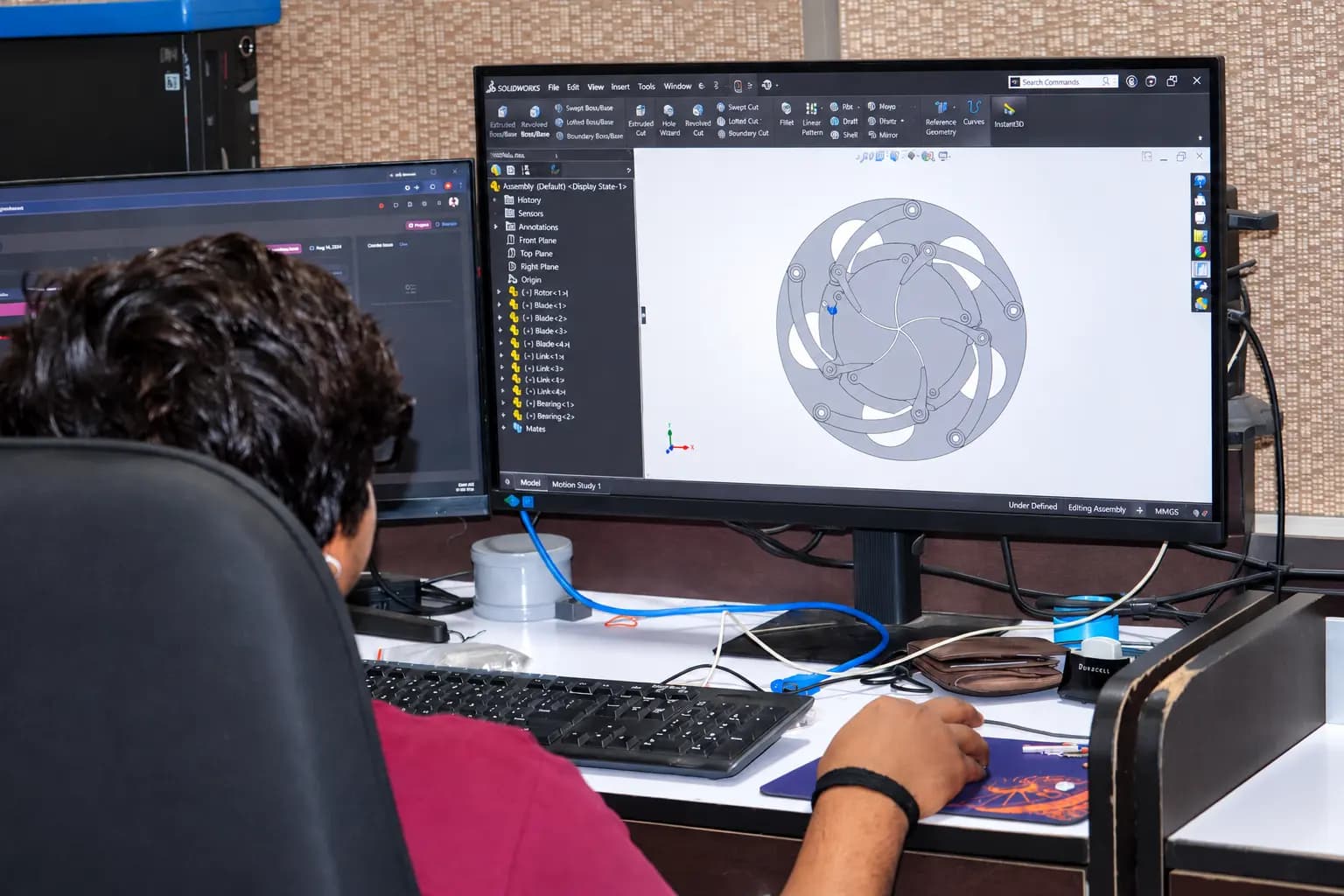
High-Precision Mechanical CAD & Kinematics
Every automated movement in our sorting machinery originates in our CAD suite. Here, an engineer refines a multi-blade iris assembly—meticulously calculating torque curves, blade clearances, and friction coefficients to achieve frictionless, repeatable diamond orientation at sub-second speeds.
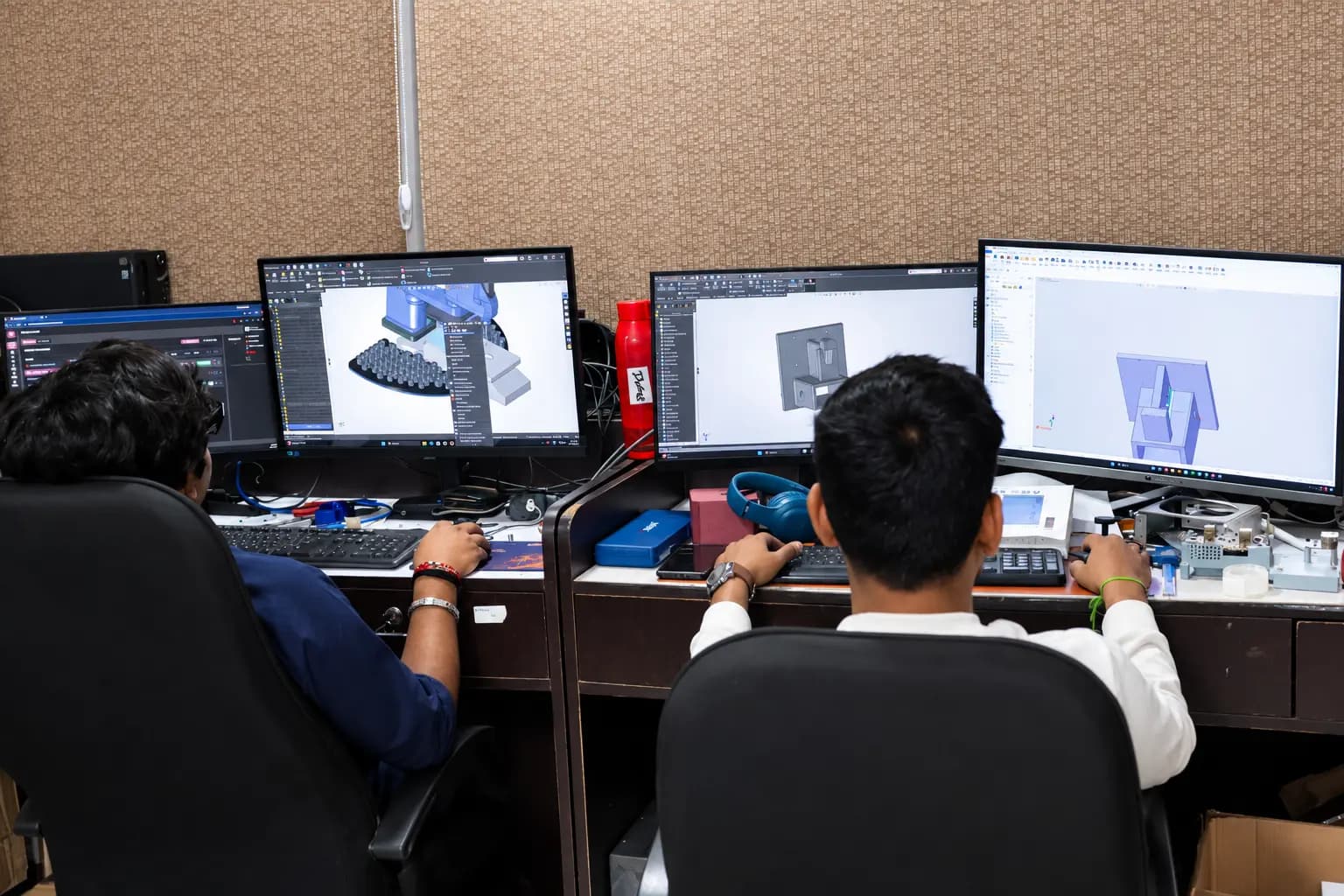
Collaborative Multidisciplinary Stations
Great hardware demands uninterrupted collaboration between software architects, mechanical designers, and electronics engineers. At our dedicated engineering pods, algorithms and physical mechanisms are tuned simultaneously—ensuring nanosecond trigger alignment between optical sensors, pneumatics, and sorting trays.
From Question to Working Technology.
Seven disciplined stages guide our multidisciplinary teams from raw inquiry through to production-ready automated systems.
Understand the problem and investigate the technology.
Every innovation starts with a precise physical, optical, or computational inquiry. We examine fundamental material behavior, optical spectra, and kinematic boundaries.